
Bringing Overlooked Histories to Light
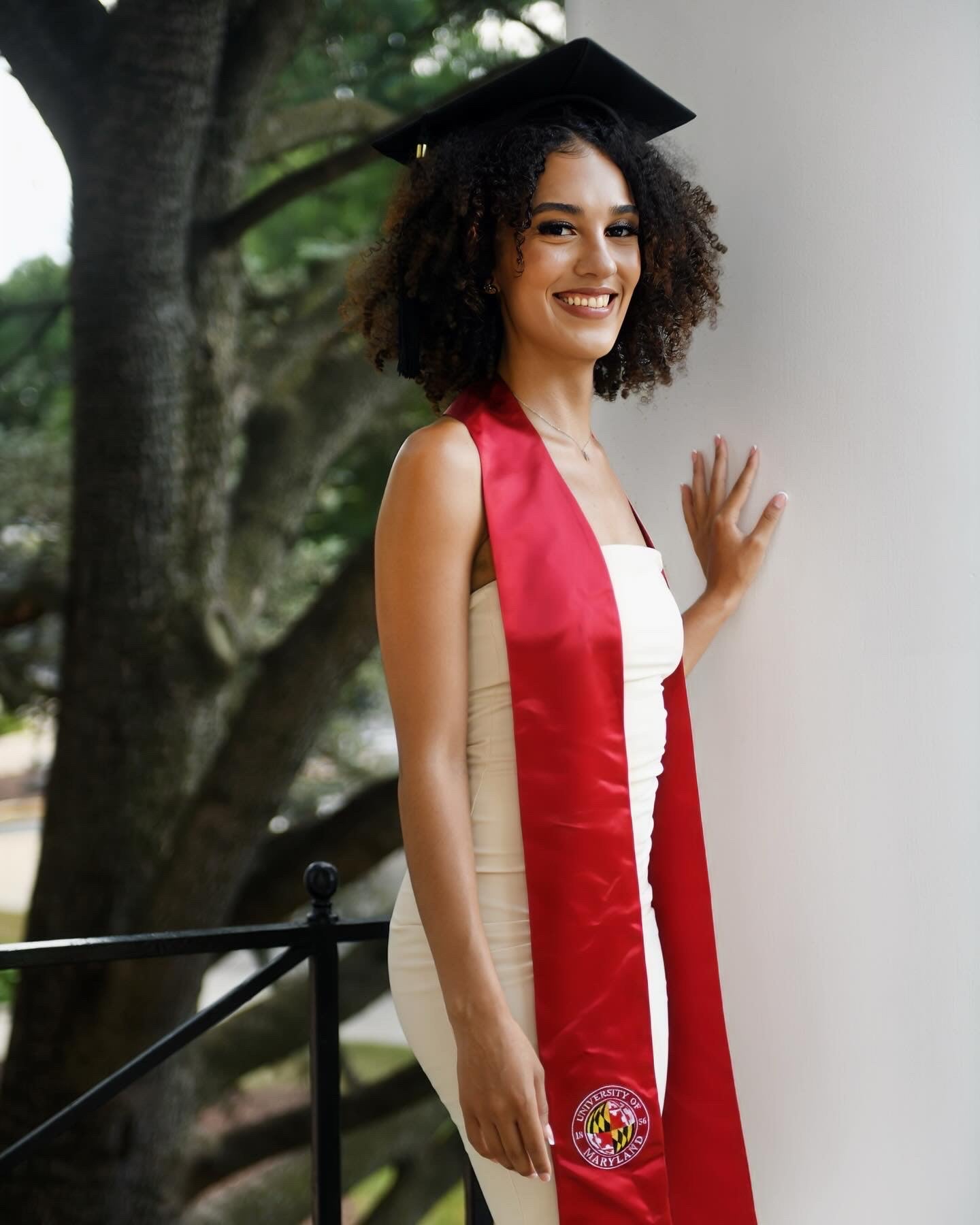 When a state official visited AbryAnna Henderson's fourth-grade classroom and asked the students what they wanted to be when they grew up, she had her answer ready: "I'm going to be a doctor and get my PhD." She didn't yet know that medical doctors don't typically earn PhDs, but the instinct that she belonged in research has, in its own roundabout way, come true.
Today, Henderson is a doctoral student in the Dietrich School's Department of Sociology, where she studies Black social movements and the activists who shape them. The path that brought her there wound through gymnastics mats, a college football training room, and an exercise physiology lab before it arrived at the questions that drive her now.
As a child, Henderson loved sports and science in equal measure.
"I did gymnastics, I was really into sports, and I really loved science," Henderson recalls. "So I thought, 'I'm going to be a sports medicine doctor and get my PhD.'"
That ambition carried her to the University of Maryland, where she majored in kinesiology with an eye toward sports medicine.
But each step she took helped clarify what she actually wanted. An internship with the University of Maryland football team taught her that athletic training wasn't her path. A research scholarship (she was the first recipient of the Whitlark Endowed Research Scholarship) placed her in an exercise physiology lab alongside PhD students, and acceptance into two research programs for minority students, LSAMP and ADAPT, deepened her experience further. As she navigated these experiences, she saw a pattern emerge.
"I realized I didn't really want to be in a lab," Henderson offers, "but I did enjoy doing research."
Her pivot came through a subfield called physical cultural studies. Henderson began taking courses like Sport and Society and Black Masculinity in Sports, and something clicked.
"I liked the discussions and how they integrated sociological concepts.”
She knew by then that she wanted a PhD, but she didn't want all three of her degrees to be in kinesiology. A professor suggested sociology, and with the support of mentors, Henderson earned a master's degree in the field at Maryland.
Her master's research examined Colin Kaepernick's decision to kneel during the national anthem, a subject that connected her longtime interest in sports to a growing fascination with the Black Lives Matter movement.
"Social movements became a big part of what I wanted to study for my PhD," she says, "Specifically Black movements."
That focus led her to Pitt.
"Pitt has a social movements–focused sociology department," Henderson explains. She was especially interested in the work of one of her two current advisors, Associate Professor Joshua Bloom. They had an early Zoom talk before she applied, which reassured her that she had found the right intellectual home under the mentorship of Bloom and fellow sociology faculty member, Associate Professor Crystal Eddins.
At the Dietrich School, Henderson recently completed her second-year paper, a milestone akin to a master's thesis, that continued her research on Kaepernick by surveying and interviewing students on campus. Now, as she begins her comprehensive exams and dissertation prospectus, she is turning toward a new project drawing on her advisor's interview data with activists from the 2014 Ferguson protests after the police shooting of Michael Brown.
"I want to focus on Black women in the Ferguson rebellion," Henderson says, "the roles they were taking on, what they were doing as activists, and how they impacted that movement."
The work, as Henderson sees it, is both a matter of filling gaps in knowledge and correcting the record. Much of the public narrative during Ferguson cast Michael Brown in a negative light or defended police actions, while activists on the ground pushed back. And while the civil rights movement has been studied extensively, far less scholarship has centered on Ferguson specifically.
"I'm trying to bring that to light," says Henderson. "Black women, in particular, are an understudied group. It's important to highlight what they were doing at that time, how they had an impact, and how that connects to the social progress we've seen and experienced collectively."
Looking ahead, Henderson intends to remain in academia as a professor and researcher while also consulting for nonprofits.
Offers Henderson, “Anything that lets me give back to the community or help in that way. That’s what feels important to me.”
Return to the July 2026 issue »