
Life experiences shape doctoral student’s analysis of childhood development
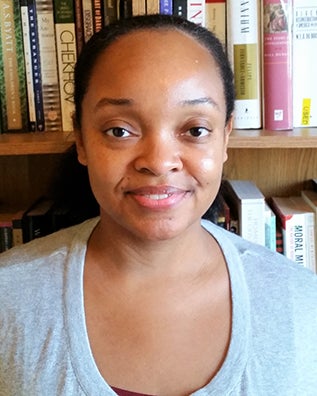 There was a time when Daphne Henry was enamored with Russian, Greek, and U.S. history. A standout student, she dreamed of becoming a writer, maybe moving to New York.
That changed, literally, in a heartbeat – the day her mother collapsed at home in 2002, falling into a coma from which she would never emerge, her sudden death a shock to her family. Doctors concluded it was bacterial meningitis; Henry theorizes that her mother had brushed off her symptoms as a sinus infection, pushing through, as she always had, until her body shut down.
Left behind were three children: Henry and her two brothers, 11-year-old Charlie, and 6-year-old Chad. And so, at the tender age of 26, the young woman who hoped to be a writer abruptly switched tacks, taking custody of two little boys who had just endured a profound loss.
Parenthood, a role she had to learn on the fly, would change the course of her life. In addition to assuming typical responsibilities, Henry also had to juggle a myriad of services and behavioral plans for Charlie, who is intellectually disabled.
She had been working for Pitt, her alma mater, helping with research support and grants at the medical school’s Department of Biomedical Informatics. It was a coincidence that proved fortuitous; as she scrambled to find resources to help her brothers, she wound up investigating her way into an entirely new career.
“Because I happened to be working in a research environment, I developed an understanding for what it means to be a scientist,” she says. She was intellectually fascinated by all she was reading about childhood development, so much so that she decided to pursue graduate training in developmental psychology.
Today, Henry is completing her dissertation for a PhD, which she expects to complete in the summer of 2017, with an eye toward landing a faculty position at a research university in the fall. Her brothers are now grown: Charlie lives in a community residence that is staffed around the clock, while Chad is a student at Lehigh University, where he is majoring in political science.
She credits the Hot Metal Bridge Program, a two-semester post-baccalaureate fellowship at the Dietrich School, with kick-starting her graduate school journey, which formally began in 2011.
As she parented one child who was an excellent student alongside another who struggled, Henry began to think more theoretically: What factors build resilience in children? She also began to think more introspectively about her own life, and what drivers helped her to succeed.
“Part of it was that I come from more modest socioeconomic origins,” she says, adding, “Academic achievement was always a source of respite for me. I never had problems of achievement that you associate with ethnic minorities and disadvantaged students.”
So she began to pursue the topic as an academic question, analyzing data from the Department of Education to determine what factors influence achievement gaps: family income levels, family routines, and community differences, for example. She also began collecting information from 60 parents of preschool-aged children to get a sense of their parenting beliefs, priorities, and goals.
While these topics have provided rich fodder for economists, sociologists, and psychologists, scholars have rarely considered how social class and race jointly shape achievement gaps, giving Henry a breadth of opportunity for future exploration. She also likes the idea of mentoring students, especially since she enjoys working with undergraduates at Pitt.
She is full of praise for her own mentors at Pitt, notably Elizabeth Votruba-Drzal, an associate professor in the Department of Psychology, and Maurine Greenwald, an associate professor in the Department of History, who has become a surrogate family member to Henry and her siblings.
“Honestly, I would talk to my friends sometimes about those years raising my brothers. I’m not sure if they went by in a flash or if they took a lifetime,” says Henry.
She remembers wondering if she would be a decent parent, not knowing what challenges would lie ahead.
“When you’re young, you kind of see the world laid out before you,” she notes. Reflecting back on her early dreams, and how she and her brothers adjusted their sails, fills her with a deep sense of pride and accomplishment.
“Overcoming those internal limitations that I put on myself is one of the things I really gained,” she says. “I can’t believe everything we all accomplished – all those experiences.”